Loading your files…

Convert AVIF to PNG, Universal Compatibility With Alpha

Convert an AVIF into a lossless PNG that opens in any app, with transparency intact.

or drop the image here

How to convert AVIF to PNG

How to convert AVIF to PNG

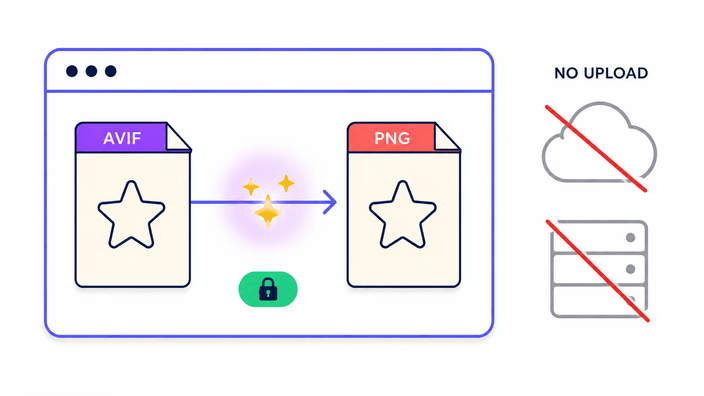
Drop an AVIF onto the upload area or click it to select a file. The browser decodes the AVIF natively and re-encodes it as PNG using its built-in support. Because both steps are native, there is no module to load and no warm-up delay. For most photos the conversion finishes in under a second. When the result is ready, the stats line shows the original AVIF size next to the new PNG size, and the PNG will be noticeably larger. Click Download to save it to your device with the same base name and a new .png extension. The PNG is ready to open in any app on your machine immediately.

Transparency is preserved

Transparency is preserved

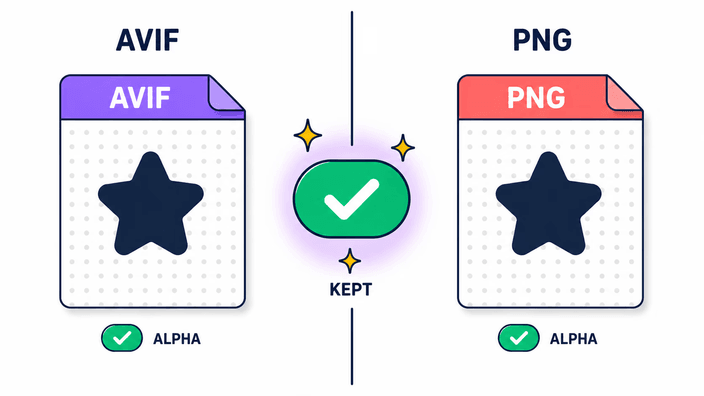
Both AVIF and PNG support full transparency, so the conversion carries every transparent area through unchanged. Nothing is flattened and no background fill is added. If your AVIF holds a cut-out subject on a transparent canvas, the PNG you download has the same cut-out on the same transparent canvas, ready to layer into a design, a slide deck, or a web layout over any background. This is the opposite of converting to JPG, which has no transparency support and replaces every see-through area with a solid color. AVIF to PNG keeps the mask intact, which is the main reason to choose it over AVIF to JPG when your asset has transparency.

Why is the PNG file larger?

Why is the PNG file larger?

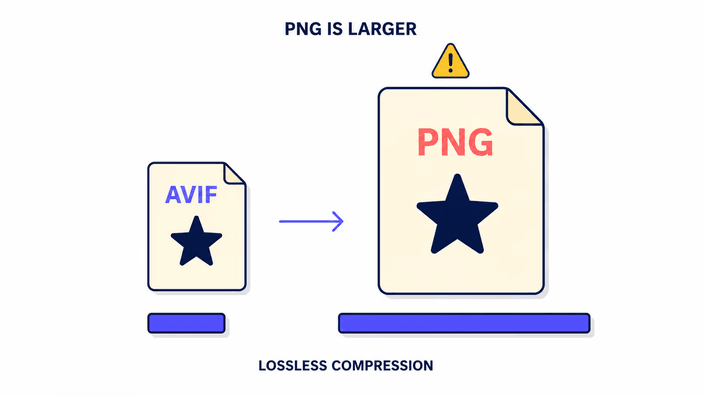
AVIF reaches its small size through compressed encoding, discarding information the eye does not notice and storing a compact representation. PNG keeps every detail exactly as decoded, with no further quality loss. When you convert AVIF to PNG, the converter expands the compact AVIF back into full image data and writes it without quality reduction, which is inherently larger. A typical ratio is three to ten times the AVIF size, depending on the content. This is not a sign anything went wrong. You trade file weight for universal compatibility and an exact intermediate that any tool can open and edit without another round of quality loss layered on top.

When to use AVIF vs PNG

When to use AVIF vs PNG

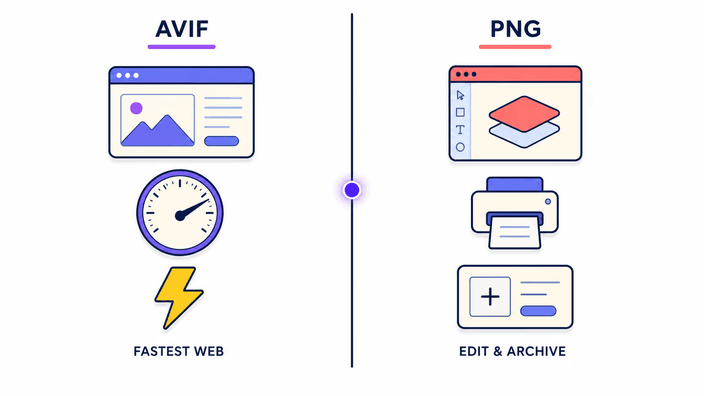
Your choice comes down to who opens the file next. AVIF excels on a modern website where the audience uses up-to-date browsers and every saved byte improves page speed. PNG is the right pick when the destination does not yet read AVIF, including older viewers, email clients, Microsoft Word and similar office tools, forum software, and content platforms that reject AVIF on upload. PNG is also the right format when you plan to keep editing, because re-saving a PNG never adds further quality loss the way a re-saved compressed format would. AVIF is your delivery format, and PNG is your working and compatibility format.

Where your file is processed

Where your file is processed

It depends on how many files you convert. Convert a single AVIF and the whole thing runs on your device: the browser's built-in image engine decodes the file and writes it as PNG, with nothing crossing the network. You can verify this by opening the Network panel in your developer tools and converting one file: you will see zero outbound image requests during the operation. Convert two or more at once and RoundCut sends them to our server, which decodes and re-encodes them in one pass and returns a single download. Files handled on the server are processed and then removed within about 2 hours. We do not keep your images, we do not ask for an account, and we do not use them for anything other than the conversion you requested. Either way the output is the same PNG, with the same transparent areas intact.

What does not yet support AVIF?

What does not yet support AVIF?

AVIF is a recent format that many tools adopted only lately. As of 2026, these commonly reject it: most email clients including Gmail and Outlook, Microsoft Word and other Office apps, pre-2025 Adobe Photoshop, several content systems including some versions of WordPress and Squarespace upload widgets, some forum software, and every version of Internet Explorer. Modern browsers, Chrome 85 and later, Firefox 93 and later, Safari 16.4 and later, and Edge 121 and later, all read AVIF natively. If the tool you need sits in the first list, converting to PNG is the fastest way to make the file work where you need it.

How it works

  1. Drop your AVIF

    Drag the AVIF onto the upload area, or click it to open a file picker and choose one from your computer, phone, or tablet.

  2. Wait for the result

    The browser decodes the AVIF natively and produces a PNG. No module needs to load, so the conversion is fast for most image sizes.

  3. Check the file sizes

    The stats line shows the original AVIF size and the new PNG size. Expect the PNG to run three to ten times larger than the source.

  4. Download the PNG

    Click the Download button to save the file with the same base name and a new .png extension, ready to open anywhere.

Related conversions

Convert the other way, or explore other AVIF workflows.

Frequently asked questions

Why convert AVIF to PNG?

AVIF is not yet accepted by many tools. Email clients, older versions of Photoshop and other design apps, Microsoft Word, many upload fields, and forum platforms still reject it. PNG opens in every image viewer and app ever made. Converting to PNG is the fastest way to make your AVIF usable in a tool that does not support it yet. PNG is also the right choice when you need an exact working copy for further editing.

Does converting AVIF to PNG preserve transparency?

Yes, always. Both formats carry full transparency support, so the conversion is straightforward: every see-through area in your AVIF arrives in the PNG exactly as it was, with no background fill and no flattening. The key contrast is with AVIF to JPG, where transparency is impossible because JPEG cannot store it. Choosing AVIF to PNG instead is the right call whenever your image has a mask you need to keep, such as a cut-out product shot, a logo, or a layered design asset.

Will PNG files be larger than AVIF?

Yes, always, and by a wide margin. AVIF uses compressed encoding to shrink files dramatically. PNG records every detail without lossy compression. When you convert AVIF to PNG, the file grows by design, typically three to ten times the original AVIF size. This is expected behavior, not a fault. You are buying universal compatibility and an exact working copy in exchange for the larger file.

Do I lose any quality converting AVIF to PNG?

The conversion itself loses no quality. PNG records each area exactly as the browser decoded it from the AVIF. If the source AVIF was created with compressed encoding, that quality reduction happened when the AVIF was first encoded. Saving as PNG preserves what the AVIF contains but cannot recover information the original encoding already discarded. The PNG is a faithful copy of the decoded source, no better and no worse.

Why can't I open my AVIF file?

The format is newer than most software. Check if your app has a recent update: Photoshop added support in 2022, Lightroom in 2024, and Affinity Photo in version 2.3. If there is no update available, converting to PNG is the quickest path forward. PNG was standardised in 1996 and every imaging tool reads it without exception. On Windows, you can also install the AVIF Image Extension from the Microsoft Store at no cost, which adds native file support without converting.

Is it safe to convert my AVIF file here?

Yes. Converting a single AVIF produces a PNG entirely on your device with nothing uploaded, which you can confirm in the Network panel of your developer tools. When you convert a batch, files travel to our server, are processed together, and the results are removed within about 2 hours. RoundCut does not retain your images after the job is done, and no sign-in is required. If your images are sensitive, use the single-file mode and your data stays on your machine throughout.

The details

Notes from the team on craft, formats, and the small decisions behind a good result.

Why AVIF decode is native and fast
Unlike AVIF encoding, which is heavy work, AVIF decoding is built directly into every modern browser. Chrome, Firefox, Safari, and Edge all ship a native AVIF decoder as part of their image pipeline, the same engine that renders AVIF embedded in web pages. So converting AVIF to PNG pays no warm-up cost and needs no extra module. The browser simply reads the AVIF, decodes it into an image buffer in memory, and hands that data to the native PNG encoder. The result is a conversion that finishes in well under a second for most real-world images, even large photographs. Only the PNG encode side varies in speed across browsers, and even the slowest observed path, around 122 milliseconds for a 1-megapixel image on WebKit, is fine for interactive use.
The lossless paradox, why PNG is bigger
It seems backwards that a conversion can make a file larger, but AVIF to PNG is exactly that case. AVIF reaches its small size by dropping visual information the eye does not notice at normal viewing distances, so its compression artifacts are real but invisible under ordinary conditions. PNG takes the opposite stance, storing every detail exactly as decoded with no further quality reduction, using only the non-lossy DEFLATE algorithm. The result faithfully represents the decoded AVIF image data without added degradation. Because the AVIF already discarded some detail, the PNG cannot be smaller than one made from the original source, but it is strictly true to what the AVIF held. Ratios of three to ten times the AVIF size are normal and expected, never a sign of error.
Editing workflows that benefit from AVIF to PNG
Designers and developers often receive AVIF files from automated image pipelines, content delivery networks, or modern content systems, then need to work with them in tools that have not added AVIF support. Converting to PNG yields an exact working copy carrying the same image data the AVIF held. From there, edits happen in Photoshop, Figma, Sketch, or any other design tool without adding compression artifacts. When the edited version is ready for the web, it can be re-exported as AVIF or WebP. This treats AVIF as the delivery format and PNG as the editing intermediate, the arrangement most compatible with current tooling. The PNG step adds no quality penalty beyond what was already present in the source AVIF.
How alpha survives the conversion
The transparency layer in AVIF is stored as a separate encoded plane alongside the color data. When the browser decodes an AVIF, it produces a color buffer and a transparency mask buffer. The conversion pipeline composites these at full transparency, then writes them out as a PNG. PNG's transparency encoding stores the mask as an 8-bit per-area channel attached to each color value. The result is a PNG where every area carries the same color and transparency values the browser read from the AVIF, ready for compositing. Soft transparency gradients survive. Feathered edges survive. Partially transparent areas survive. The only loss is whatever the AVIF's own compressed encoding introduced on the transparency plane when the AVIF was first created, usually a barely perceptible fringe at extreme zoom.
When AVIF to PNG is right for web delivery
Some web contexts genuinely require PNG even in 2026. Email newsletter images must be PNG or JPG because most email clients parse images on a remote server and reject AVIF. Social platforms vary: some process AVIF on upload and convert internally, others simply refuse the format. Print workflows running software PDF pipelines often need PNG for transparent layers, since AVIF is not part of the PDF imaging model. Open Graph preview images benefit from PNG or JPG because link-preview scrapers run on infrastructure that may lack AVIF decoding. For these delivery targets, converting to PNG is not a step backward but the correct choice given the destination system's constraints. The compatibility is worth the extra bytes.
How processing differs from a typical online tool
Most online AVIF converters upload every file you give them to machines you do not control, and hold the result under whatever retention policy the provider sets, often vague. RoundCut splits the work by how much you convert. A single AVIF is decoded and re-encoded entirely on your device, so nothing is uploaded for that case. When you convert two or more at once, the batch goes to our server, which does the decode and encode in one pass and returns a single download. Those files are processed and then removed within about 2 hours, without asking for an account and with no use beyond the conversion you asked for. There is no permanent storage and no sharing of your images. For developers handling client assets or proprietary imagery, the trade is straightforward: one image stays with you, a batch passes through our server only to produce your PNGs, and nothing lingers.